Chamunda Camunda Indian bronze
Rare Image of Camunda (Chamunda)
Northern India or Pakistan
10th century
height: 13.9cm
The goddess Camunda, a grotesque manifestation of Devi, sprung from the brow of Kali (another aspect of Devi) to defeat the demons Canda and Munda. She became known as Camunda, a contraction of Canda and Munda after successfully completing this mission. By tradition, the goddess haunts cremation grounds or fig trees.
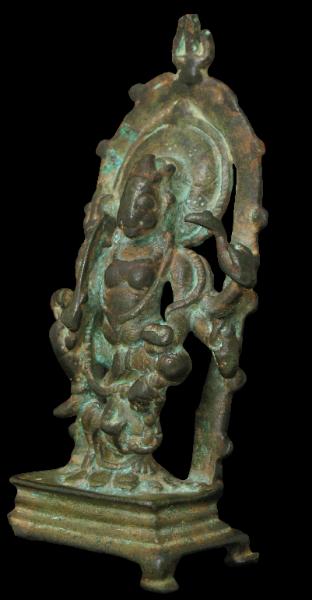
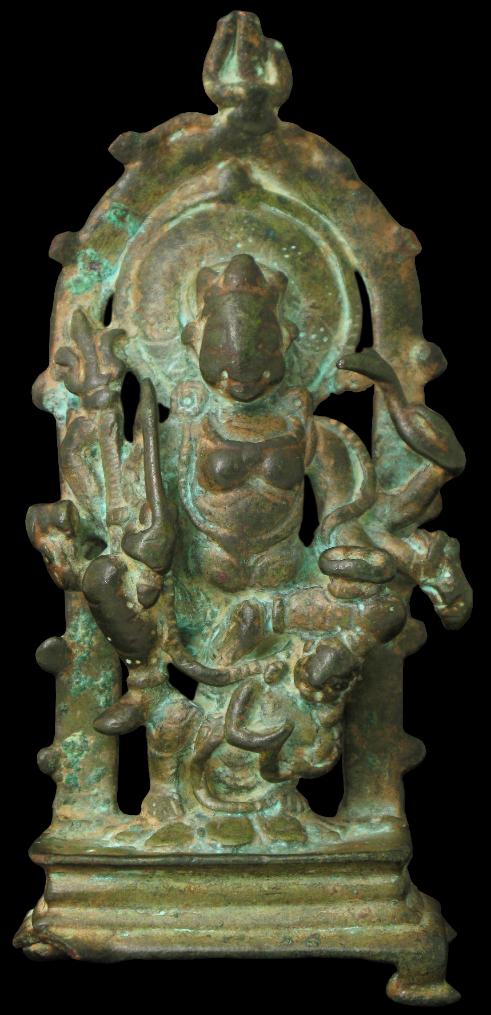
In this image, Camunda bug-eyed and with fangs protruding from her mouth, sits on the body of Canda, one of the defeated demons. The severed head of Munda is held in her middle left hand. The lower left hand holds a skull cup which by tradition is brimming with blood. The upper left hand holds a writhing snake.
The three left hands hold a sword, a double skull drum and a trident or trisular respectively.
She wears a yajnopavita (a sacred thread worn by mostly Hindu male priests) that comprises skulls and which falls from her neck to her feet, and a jata mukuta headdress.
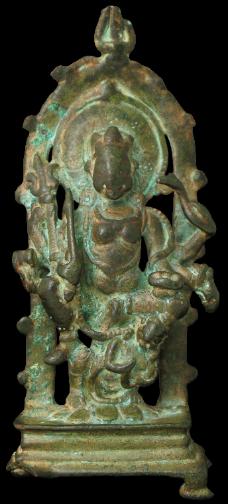
Camunda and Munda rest on a petalled dais, which is on a rectangular platform. A flaming mandorla rises from the platform; the aureole behind Camunda’s head is engraved in the form of an open lotus petal.
Images of the goddess often show a shrunken, skeletal body and appear on the exterior walls of shrines dedicated to Shiva or to Devi, but this image is rather fleshy. It has an even green patina, and contours smoothed by time and weathering. One of the front legs of the platform now is missing but this is a minor loss given the great age and rarity of this image – the image nonetheless stands upright in a stable and solid manner as if all four feet were present. Overall, this is a most interesting and unusual piece.
References:
Dye, J.M., The Arts of India: Virginia Museum of Fine Arts, Philip Wilson Publishers, 2001
Inventory no.: 749
SOLD