
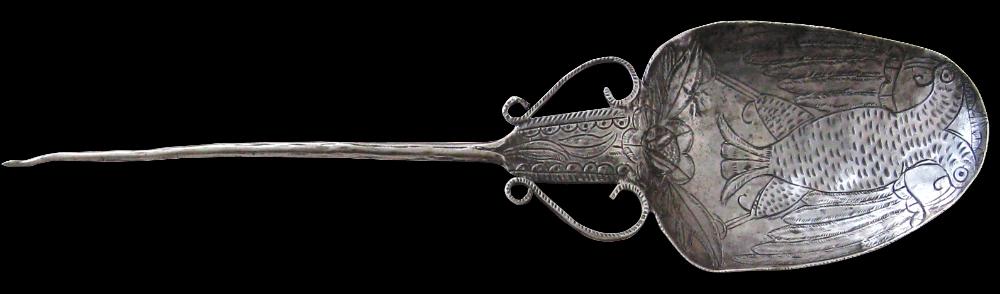
Spanish colonial silver – tupu
Engraved Silver Shawl Pin (Tupu)
Peru
18th century
length: 26.4cm, weight: 58g
This silver cloak or garment pin or tupu (also known as a topo) has a prominent spoon-shaped finial engraved with a double-headed eagle over a flower and foliage motif. It is attached to a long pin.Tupus were worn point facing upwards to hold the dress together and to pin the cloak or shoulder mantle (lliclla) about the shoulders. They were a prominent means of displaying wealth and finery for women across the Andes. Worn in pairs, the pins were worn in both pre and post colonial times, although the styles of the pins changed with colonialism.
A very similar
tupu is illustrated in Argent d’Argentine (1992) which is ascribed to Bolivia and to the eighteenth century.
References
Tupus of similar form are illustrated in Phipps, E. et al, The Colonial Andes: Tapestries and Silverwork 1530-1830, Metropolitan Museum of Art/Yale University Press, 2004 (p. 357); Taullard, A., Plateria Sudemericana, Ediciones Espeula de Plata, 2004; Argent d’Argentine, Association Francaise d’Action Artistique, 1992 (p. 113)
Provenance
European art market.
Inventory no.: 826
SOLD
for another example of a tupu.