Enquiry about object: 10336
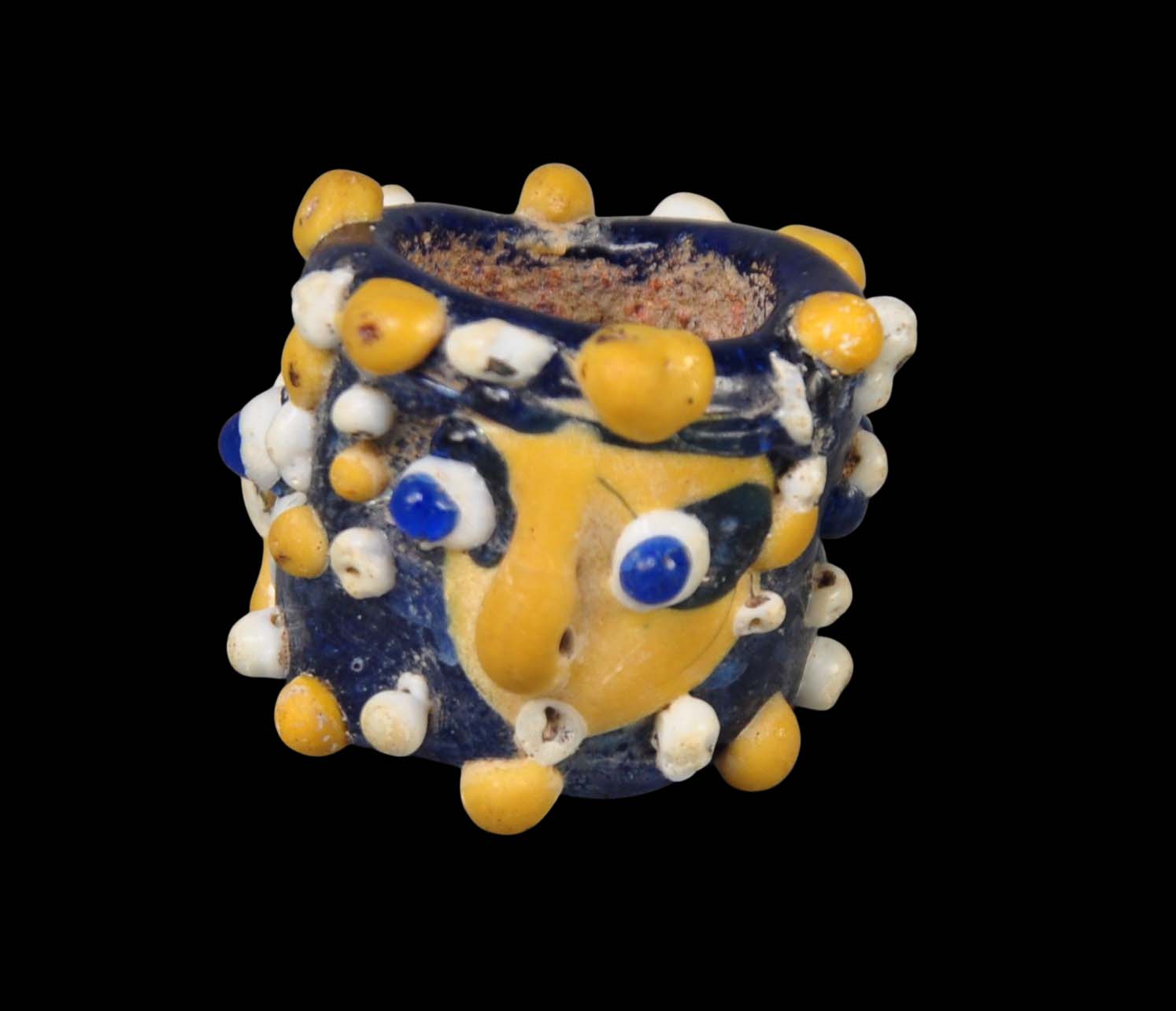
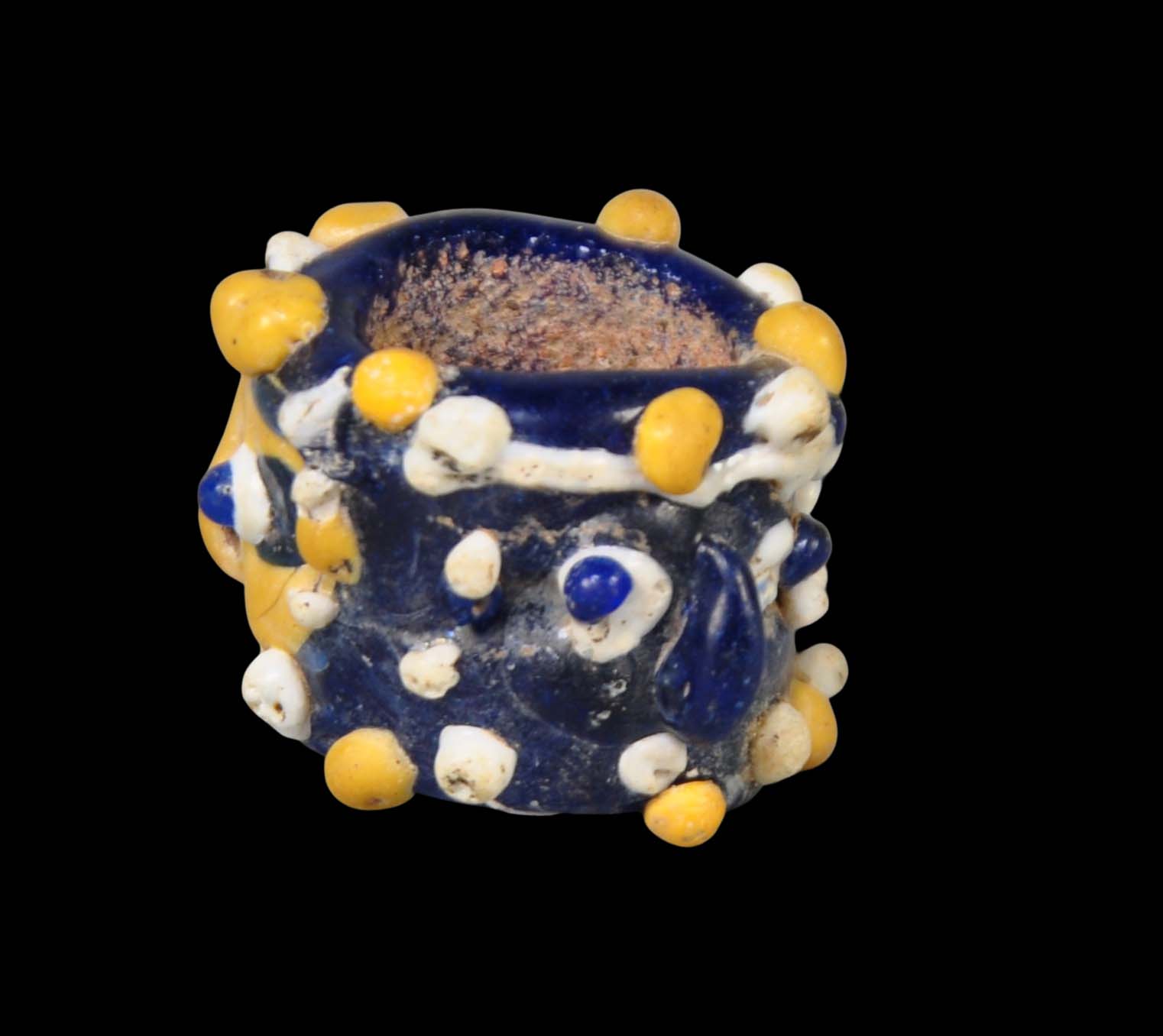
Ancient Phoenician Janiform Core-Formed Glass Face Bead
Phoenician Culture, Eastern Mediterranean or North Africa late 5th–mid-2nd century BC
width: approximately 3cm, length: approximately 2cm, weight: 15g
Provenance
Estate of Sheikh Saud bin Muhammed Al Thani of Qatar
This Phoenician wire-wound glass bead in yellow, white translucent blue and cobalt blue glass is an excellent example of such a bead. Such beads are around 2,500 year’s old. (The Phoenicians were based mostly in present-day Lebanon but established trading outposts around the Mediterranean, including in Cadiz, Spain).
The bead is cylindrical, wide, and with rounded edges on both ends.
It is decorated with three faces, one with a white background, one with yellow and one with blue. The details of each are of applied glass. The top and bottom are further decorated with applied yellow glass granules. The granules were applied whilst the underlying glass was still molten as they are embedded in the underlying glass and fused with it.
The interior of the perforation has the necessary ancient mandrel release or core residue – it is matt and is encrusted with either fine sand or kaolin-type clay. Such an interior is a necessary sign of antiquity and ancient manufacturing processes.
It is likely that such beads were used for talismanic purposes, with the faces meant to repel the Evil Eye. Such bold and colourful amulets were thought to divert the Evil Eye’s attention away from the wearer.
It is not known where precisely this type of large face bead was produced. Their known findspots include Phoenician and Carthaginian (originally a Phoenician outpost) sites. They are believed to have been made in the same workshops as other large head glass pendants with demonic masks, bearded male heads, or rams’ heads. In any event, the Phoenicians were a trading culture and it is highly likely that the beads were transported and traded around the Mediterranean following their trade routes.
Such beads were made by a winding or core-formed technique. Glass was shaped over a core of friable material. It was then worked with successive layers of coloured glass which were separately fired in a kiln. Decorative elements were also added and the bead was fired again. (It is likely that this repeated firing and heating of the glass meant that some of the applied components appear to have ‘slipped’ or run from where they should be.) Once the bead was finished, the core would be dragged out using a pointed tool.
A similar example is in the Metropolitan Museum of Art. That example was a gift of Gift of J. Pierpont Morgan in 1917. A related example was offered at Bonhams London. Another example is in the Hermitage Museum, St Petersburg.
The bead is from the estate of Sheikh Saud bin Muhammed Al Thani of Qatar, a profligate collector. The Sheikh passed away in 2014.
The bead is in fine condition. As might be expected, there is wear, pitting, erosion, encrustation and some losses to the applied extremities, but largely it is intact, bright and robust. Overall, it is an unusually fine example.
References
Kunina, N., Ancient Glass in the Hermitage Museum, St Petersburg, 1997.
Liu, R.K., A Universal Aesthetic: Collectible Beads, Ornament, Inc, 1995.
Sherr Dubin, L., The Worldwide History of Beads, Thames & Hudson, 2009.