Enquiry about object: 9938
Burmese Shan Inscribed Buddha
Shan States, Burma (Myanmar) 18th-19th century
height: 25.9cm, width: 13.4cm, depth: 8cm, weight: 1,260g
Provenance
UK art market
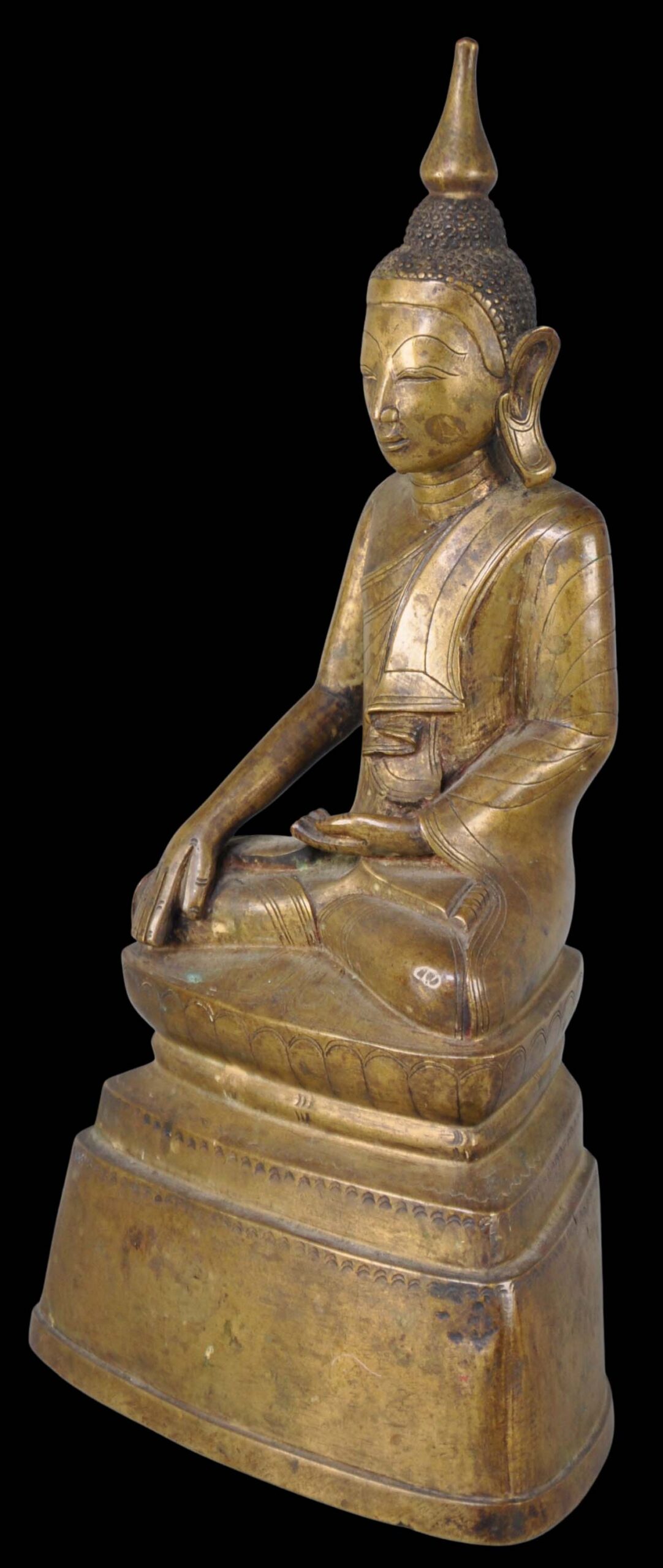
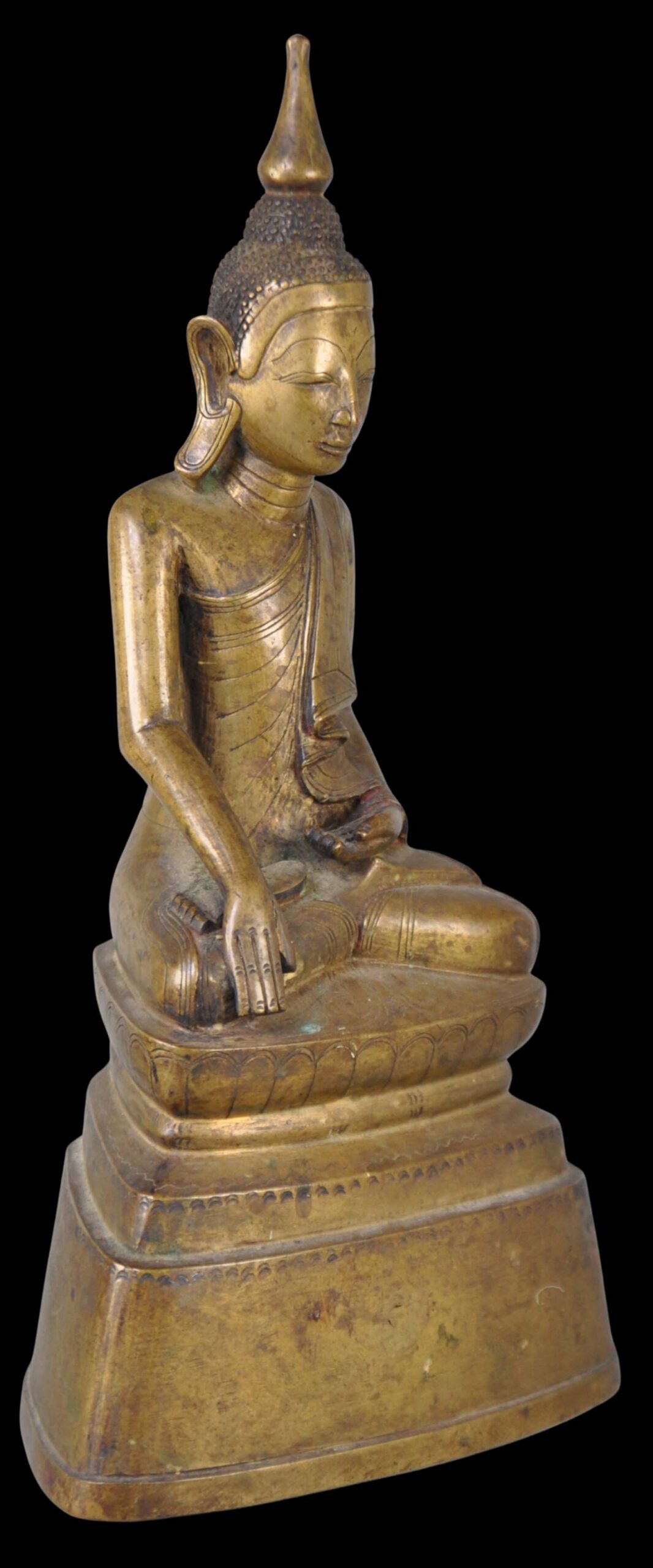
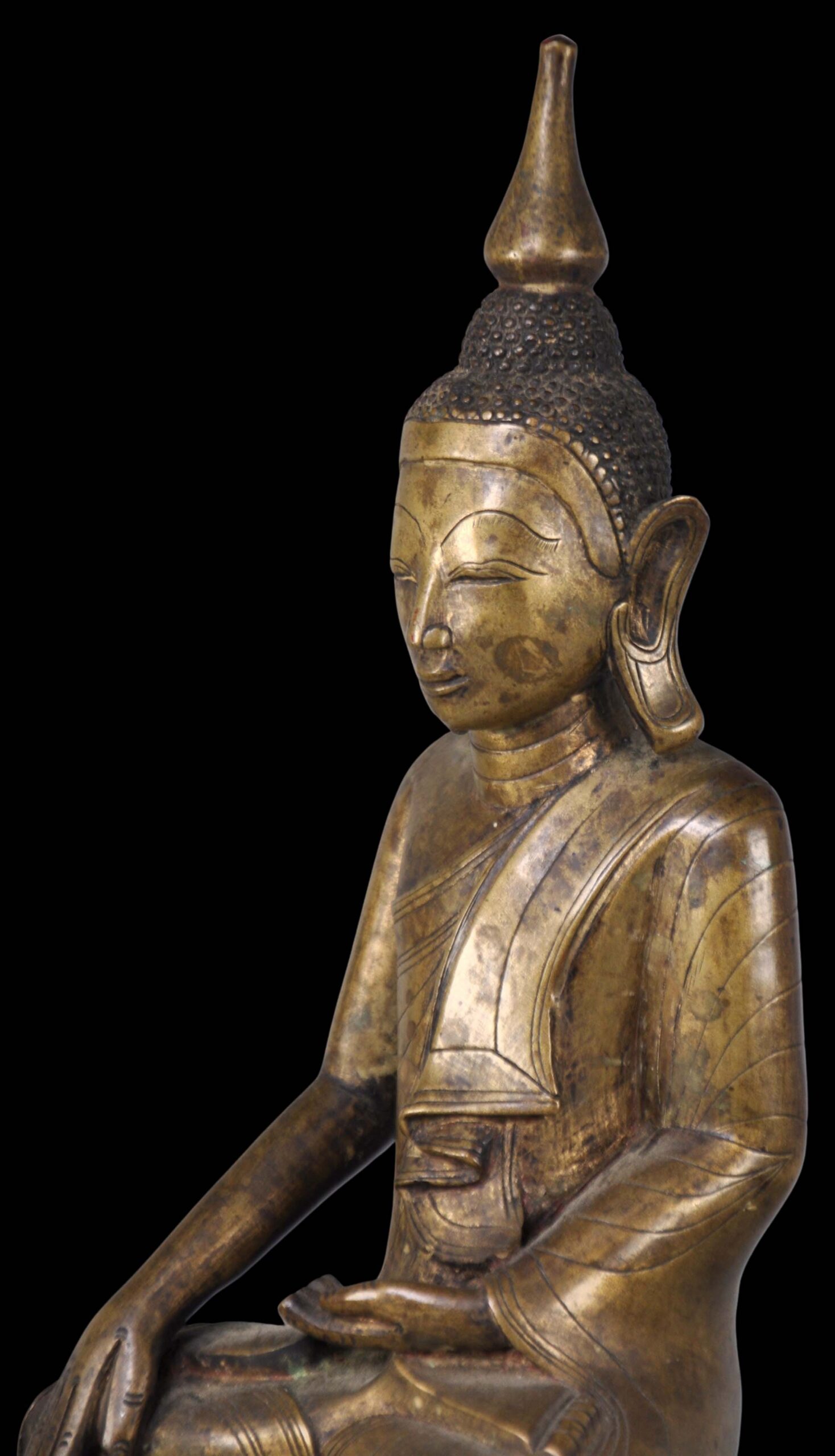
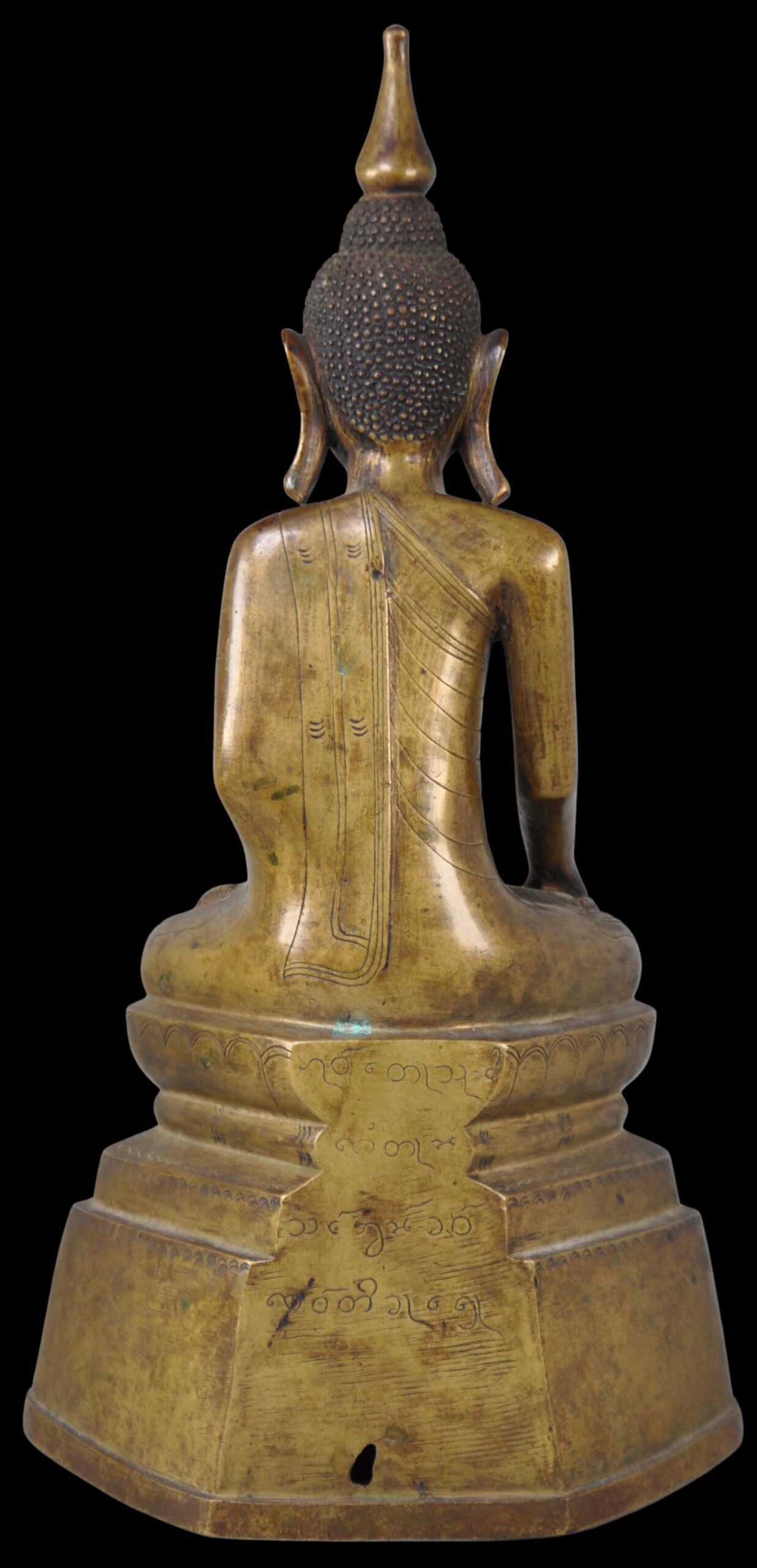
This Buddha from the Shan States of Eastern Burma, is particularly elegant. The face is fine and pleasing, and the pleats of the robes are well rendered.
The Buddha sits in the ‘earth touching’ or bhumispara position, also known as the ‘calling the earth to witness’ pose, whereby the Buddha, seated in meditation under the Bodhi tree on the evening before his enlightenment, is challenged by the demon Mara to prove that he had given alms. The Buddha touched the ground with his right hand and asked the earth to bear witness to his past good deeds (Fraser-Lu & Stadtner, 2015, p. 152).
The image has been cast as a single piece with the elongated features often seen among Shan Buddha images. The head faces essentially forward but with a slight downward tilt. The face has a world-weary expression. The eyes are half-closed, and the eyebrows are arched and prominent. The nose is almost acquiline and flared. The lips are pursed and with a slight smile. The ears are elongated – they are those of a prince – to the point that the lobes rest on the shoulders. The hairstyle is akin to neat rows of peppercorns.
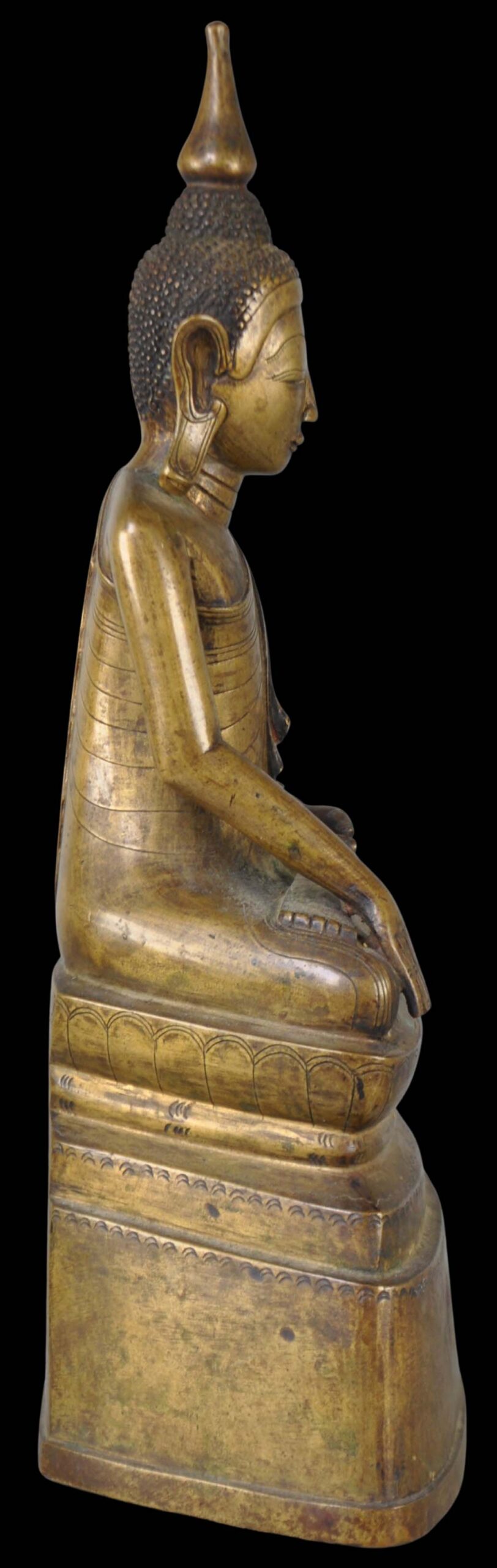
The image wears the robes of a monk. His right shoulder has been left bare. He sits on a high, tiered throne that is sharply waisted in the middle. Such thrones are characteristic of Burmese and Shan Buddha thrones. The plump, bud-like jewel to the top of the Buddha’s head is also peculiar to Burmese and Shan images and seems to have its origins in seventeenth century representations of the Buddha (Lowry, 1974).
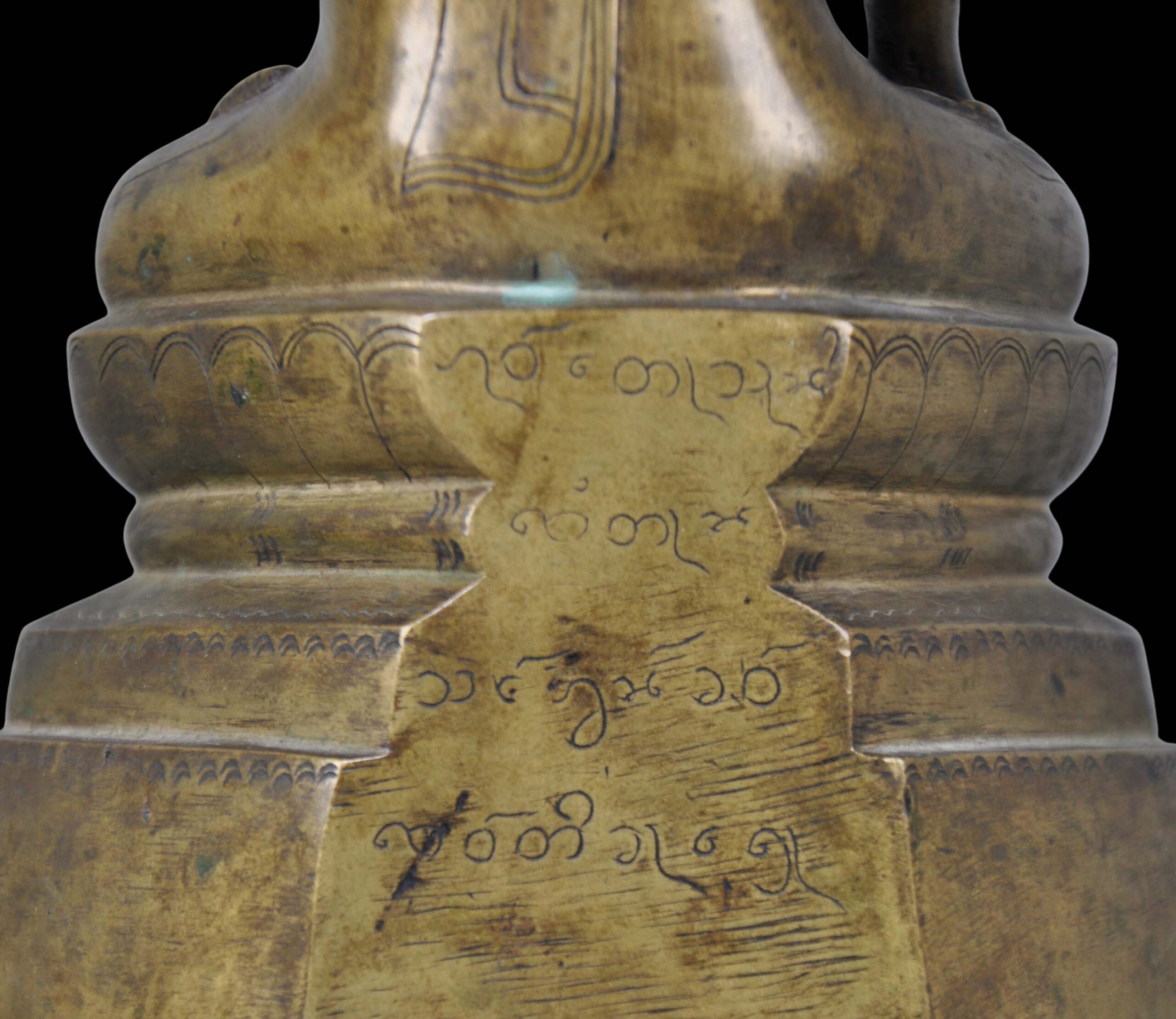
There is a flattened cartouche at the back of the throne which is engraved with a dedicatory inscription, and the throne itself has been incised with petal motifs.
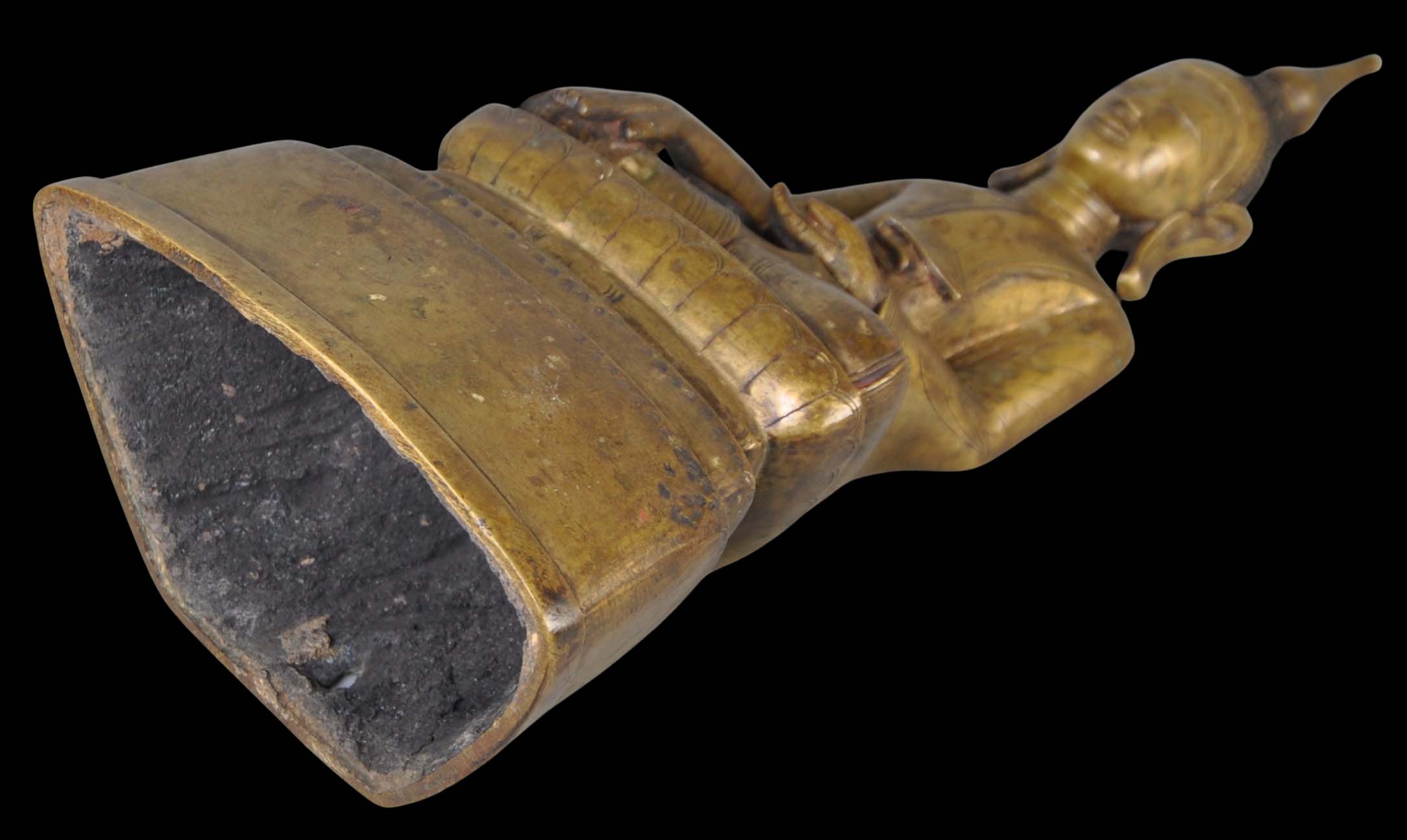
The image is in excellent condition and has an encrusted, varying surface consistent with good age.
It sits evenly, without rocking. It was acquired in the UK and no doubt arrived in the UK during the colonial era.
References
Fraser-Lu, S., & D.M. Stadtner, Buddhist Art of Myanmar, Asia Society Museum, 2015.
Karow, O., Burmese Buddhist Sculpture: The Johan Moger Collection, White Lotus, 1991.
Lowry, J., Burmese Art, Victoria and Albert Museum, 1974.
Somkiart Lopetcharat, Myanmar Buddha: The Image and its History, Siam International Books Company, 2007.