Enquiry about object: 10568
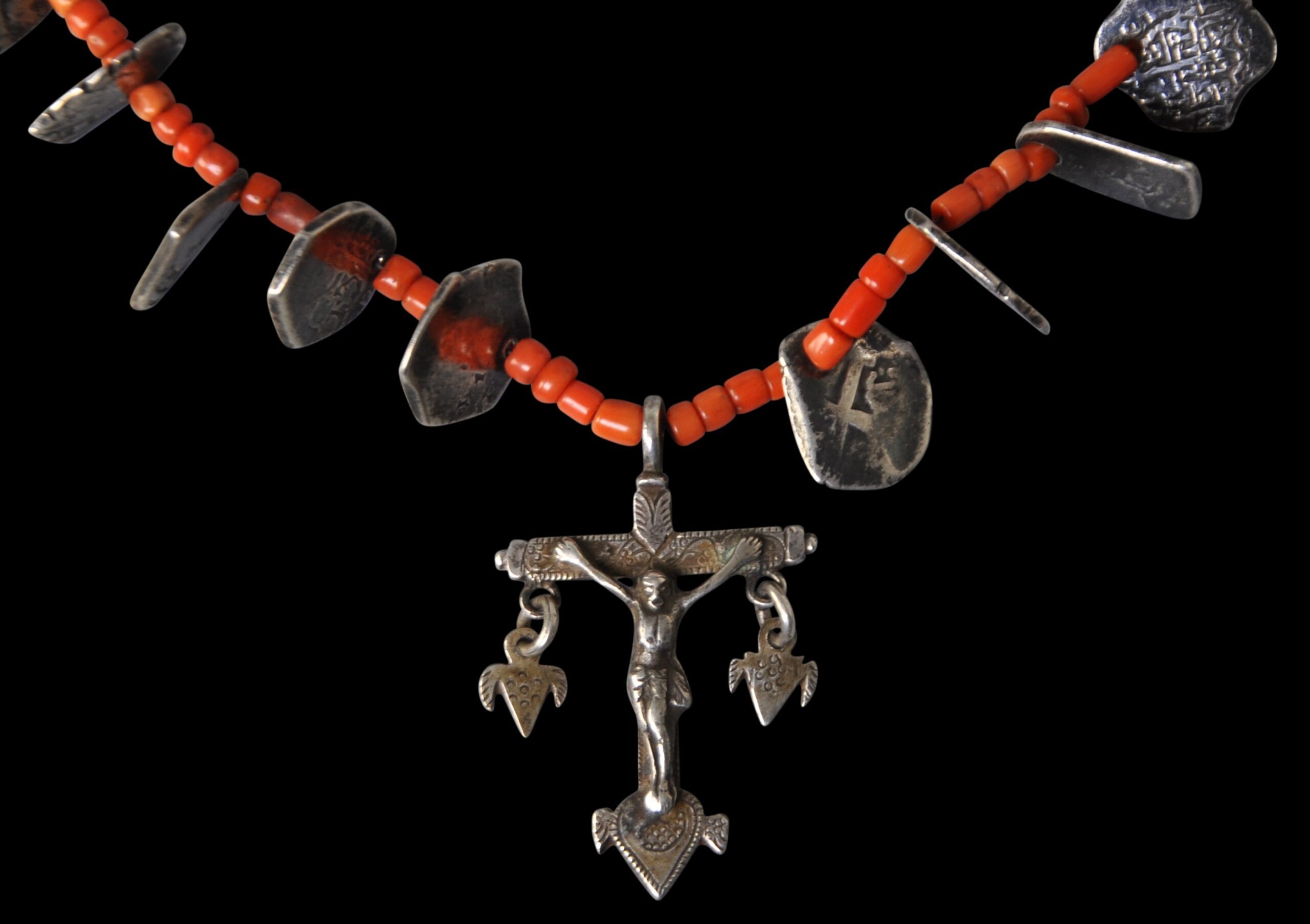
Guatemalan Coral & Silver Spanish Cob Necklace & Crucifix Pendant (Chakal)
Maya People, Guatemala 19th century
circumference: approximately 68cm, length of cross: 6.3cm, weight: 163g
Provenance
private collection, UK
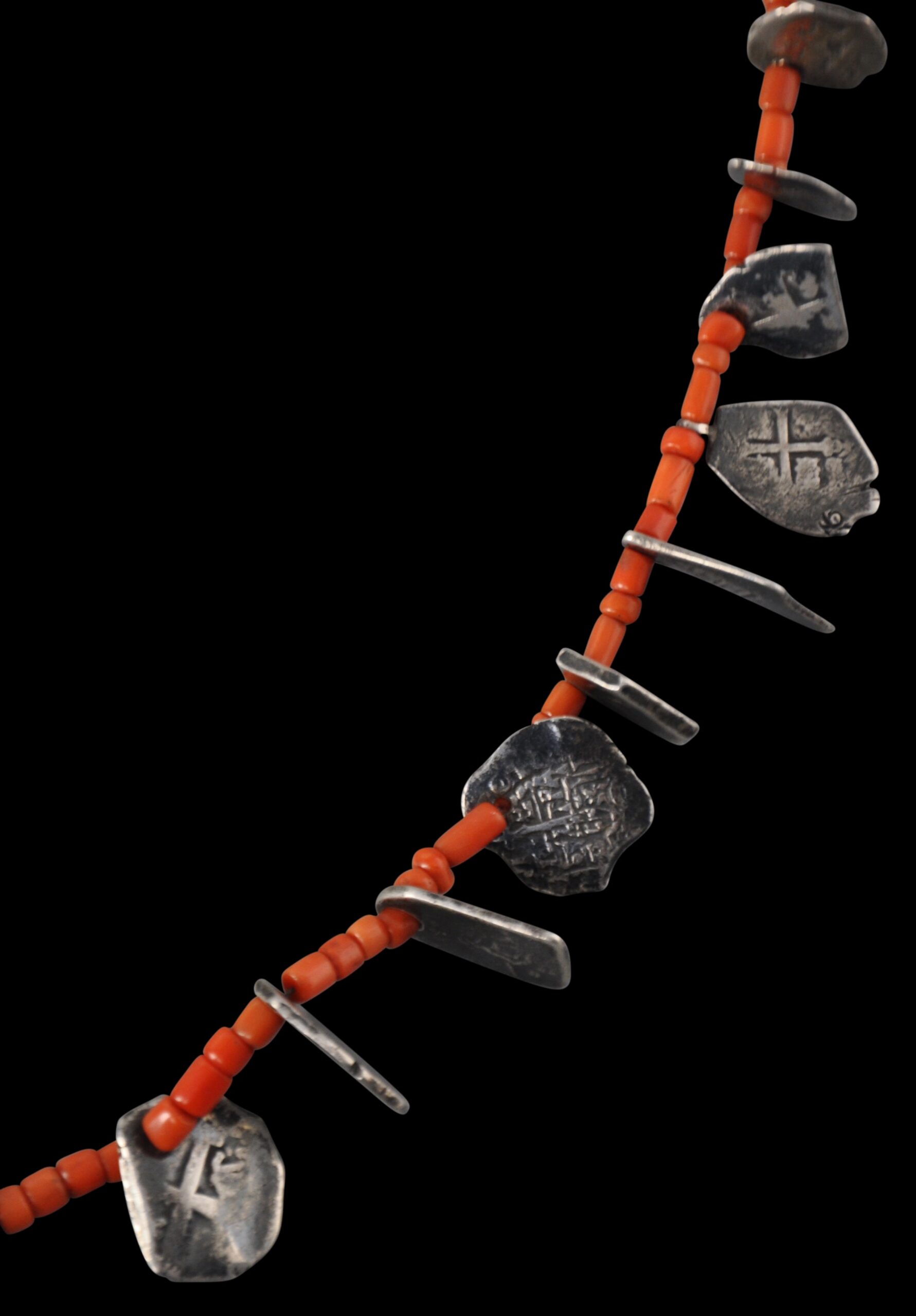
This splendid traditional chakal necklace from the indigenous Maya people of Spanish colonial Guatemala comprises dozens of high-quality, natural coral beads and 37 Spanish silver cobs. The necklace supports a silver Crucifix showing the crucified Christ in high relief and with stylised bird-like pendants suspended from the arms of the Cross. The Crucifix is engraved on its reverse with scrollwork and stylised bird (probably doves) motifs.
The Maya comprise almost half of Guatemala’s population. Traditionally, they wore necklaces of coral as a prestige, status item. After the Spanish conquest and their conversion to Christianity, silver and Christian silver elements were added. As coral became scarce, other beads were substituted, so it is important that this example uses genuine, old coral.
The Spanish silver cobs date from the 17th and 18th centuries. The cobs are hand-struck, irregular silver coins minted in the Spanish American colonies, though with the Galleon trade, they circulated in the Philippines too. The earliest examples were known as macuquinas.
Typically, they have thick, chunky, irregular shapes with off-center strikes. Their thicknesses vary as is the case with those in the necklace here. They were valued for their metal content rather than appearance, and so effectively served as small silver ingots.
The term ‘cob’ comes from the Spanish ‘cabo de barra’ meaning ‘end of the bar’ – cobs were sliced from silver bars.
Generally, they were struck with the Spanish coat of arms (castles and lions) on one side, and a Jerusalem cross on the other, or the Pillars of Hercules with the motto Plus Ultra. However, often they are worn to the point that this detail is obscured. They were produced mostly in Mexico City, Potosí (Bolivia), Lima (Peru), and Antigua (Guatemala), and were traded across South and Central America in the 17th, 18th and early 19th centuries. They had differing denominations which included the 1/2, 1, 2, 4, and 8 reales (the famous ‘Piece of Eight’).
A related necklace but with dark glass beads rather than coral is illustrated in Leurquin (2003, p. 403).
The necklace is fully closed, but can slip over the head. It is stable and wearable.
References
Leurquin, A., A World of Necklaces: Africa, Asia, Oceania, America from the Ghysels Collection, Skira, 2003.
Sierra de la Calle, B., Filipinas: Obras Selectas del Museo Oriental, Museo Oriental, Valladolld, 2004.