Enquiry about object: 10539
Extremely Rare, Large, Jain Steatite Devotional Box
Jain community, Karnataka or southern Maharashtra, South India 17th century or earlier
height: 11.4cm, width: 34.5cm, depth: 25.1cm, weight: 15,070g
Provenance
UK art market, almost certainly in the UK since colonial times
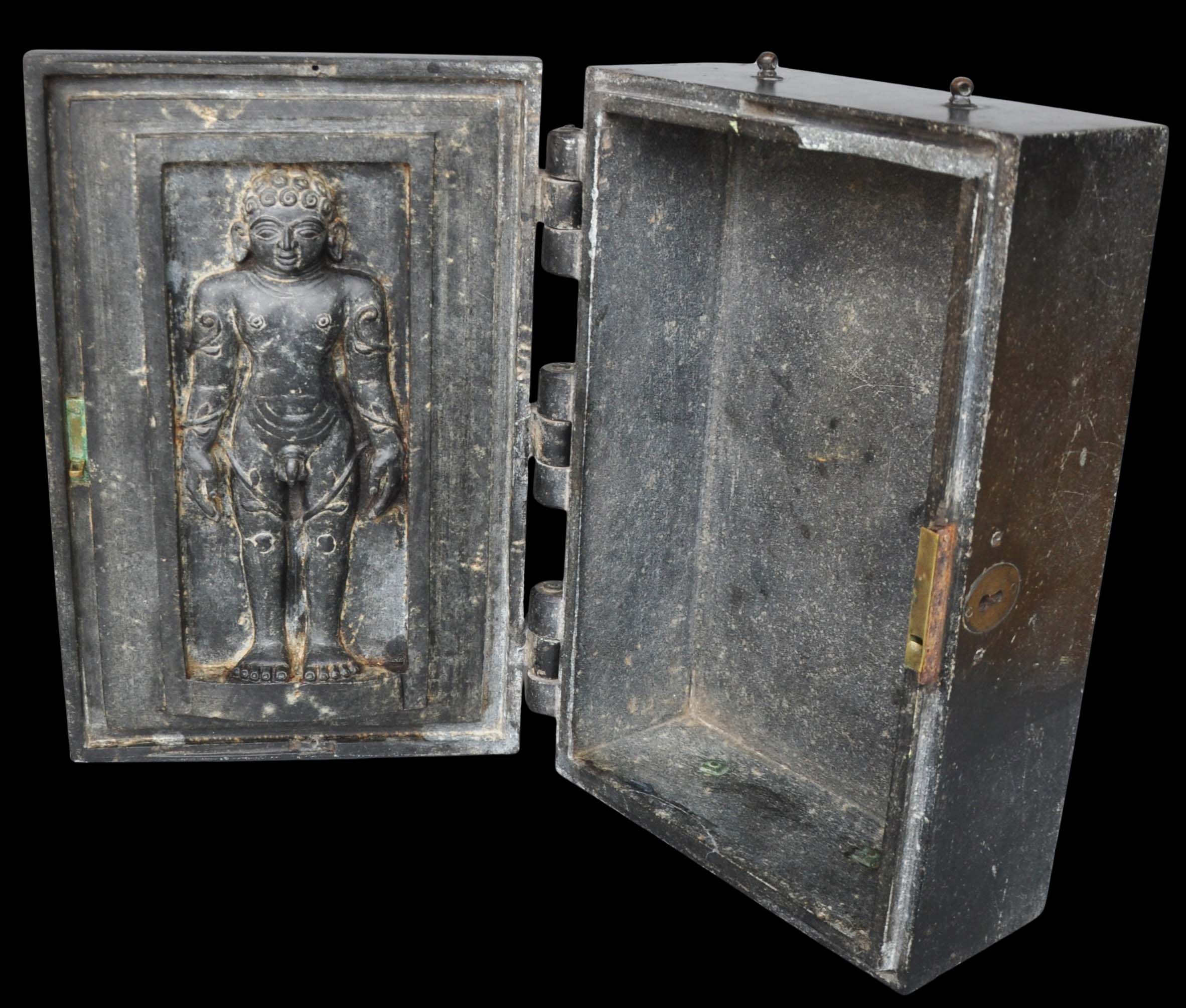
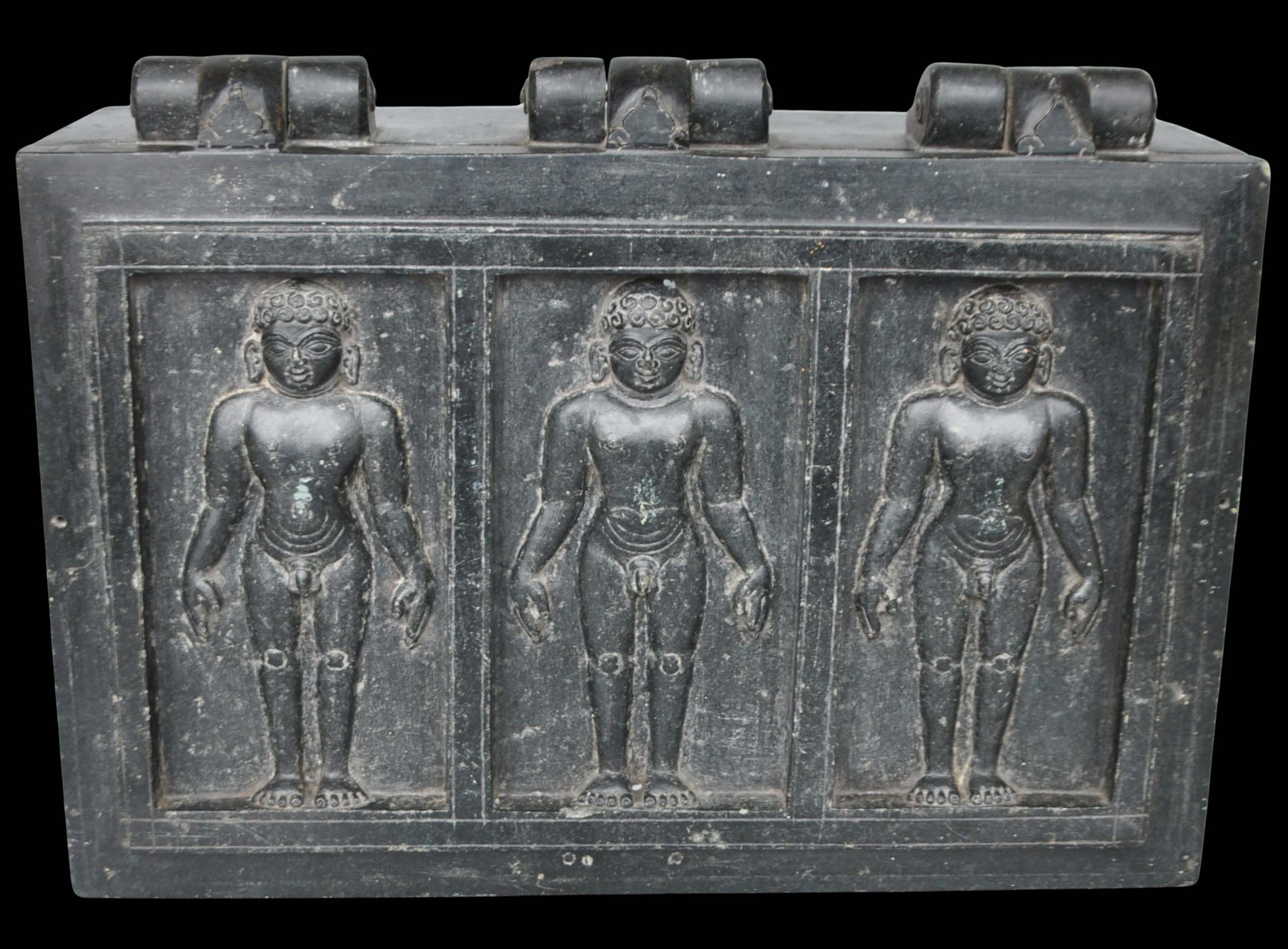
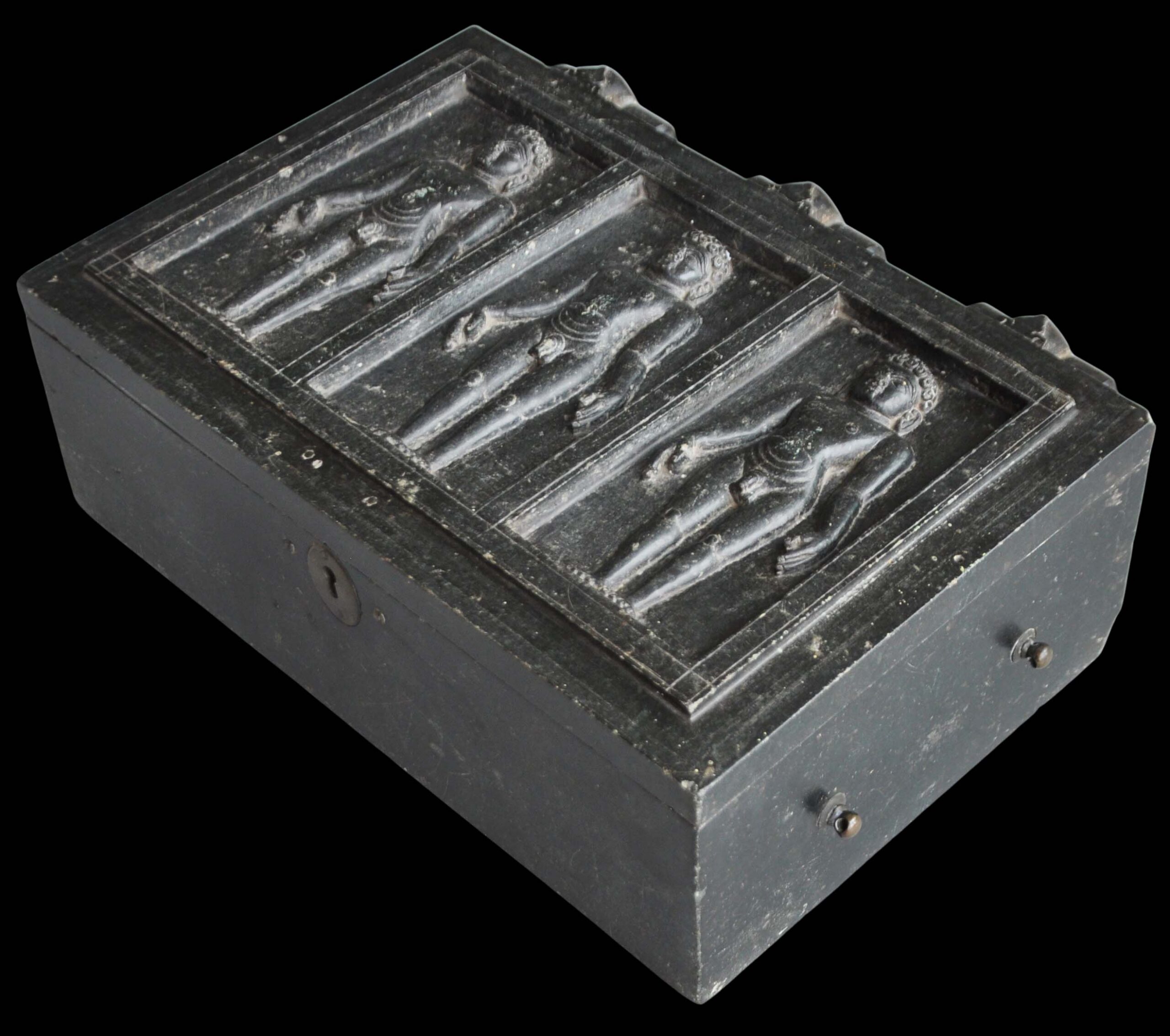
This outstanding, large, rare Jain shrine box carved from grey-black steatite is of enormous importance. It is a much larger example of what until now seemed a unique Jain box in the British Museum (and currently displayed among the permanent collection).
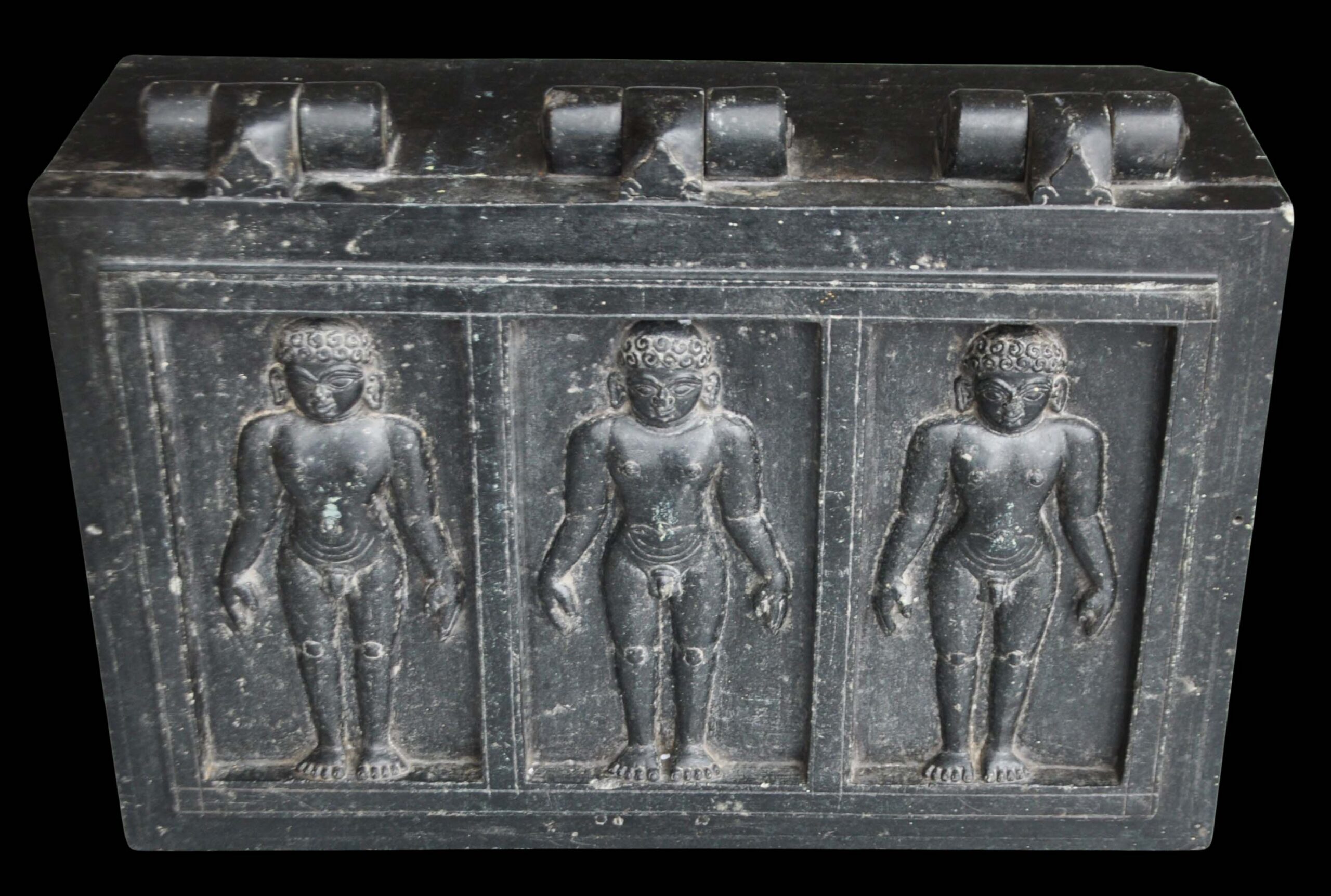
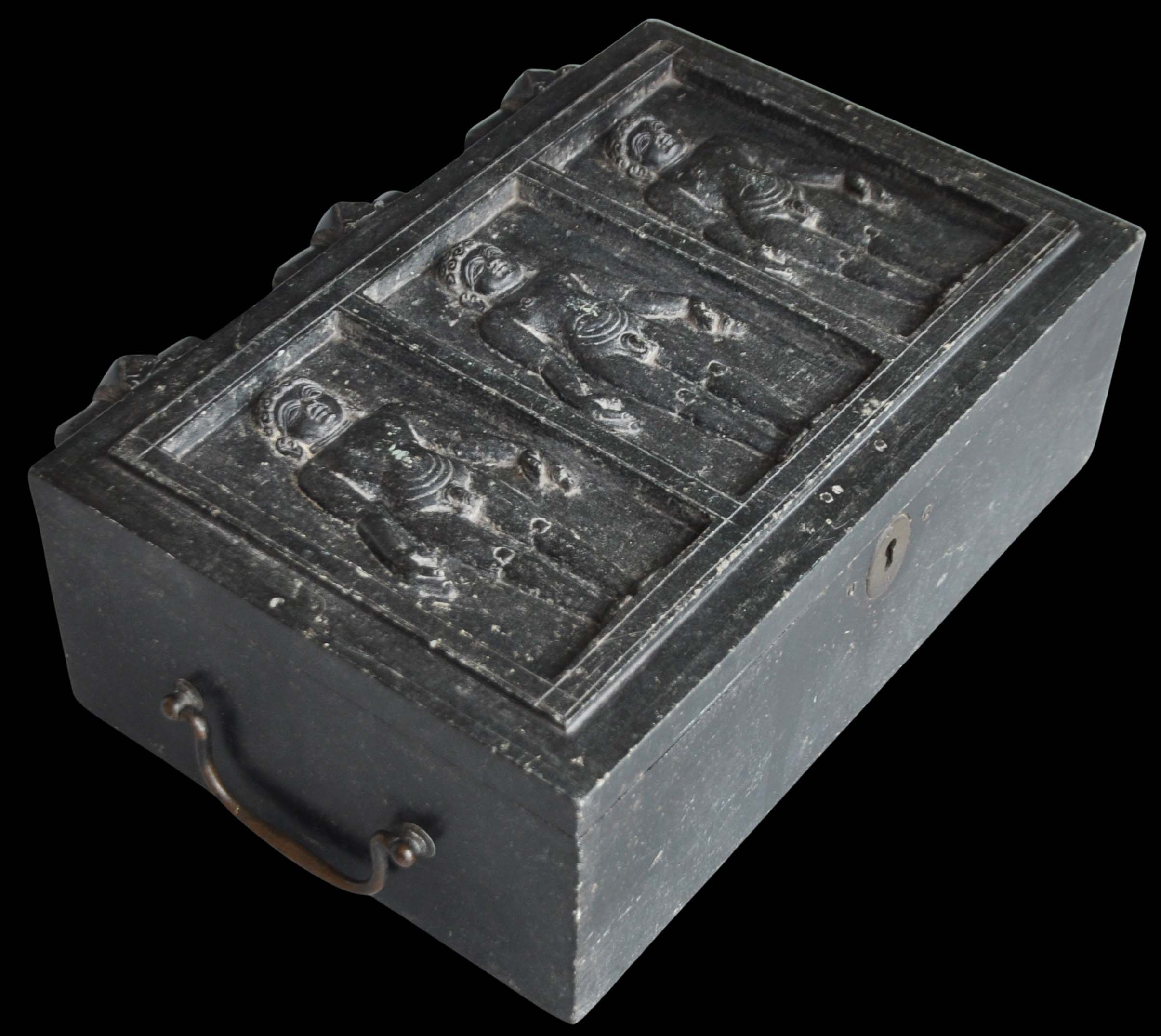
It has three images of naked, standing jinas or tirthankaras (enlightened teachers) carved to the lid.
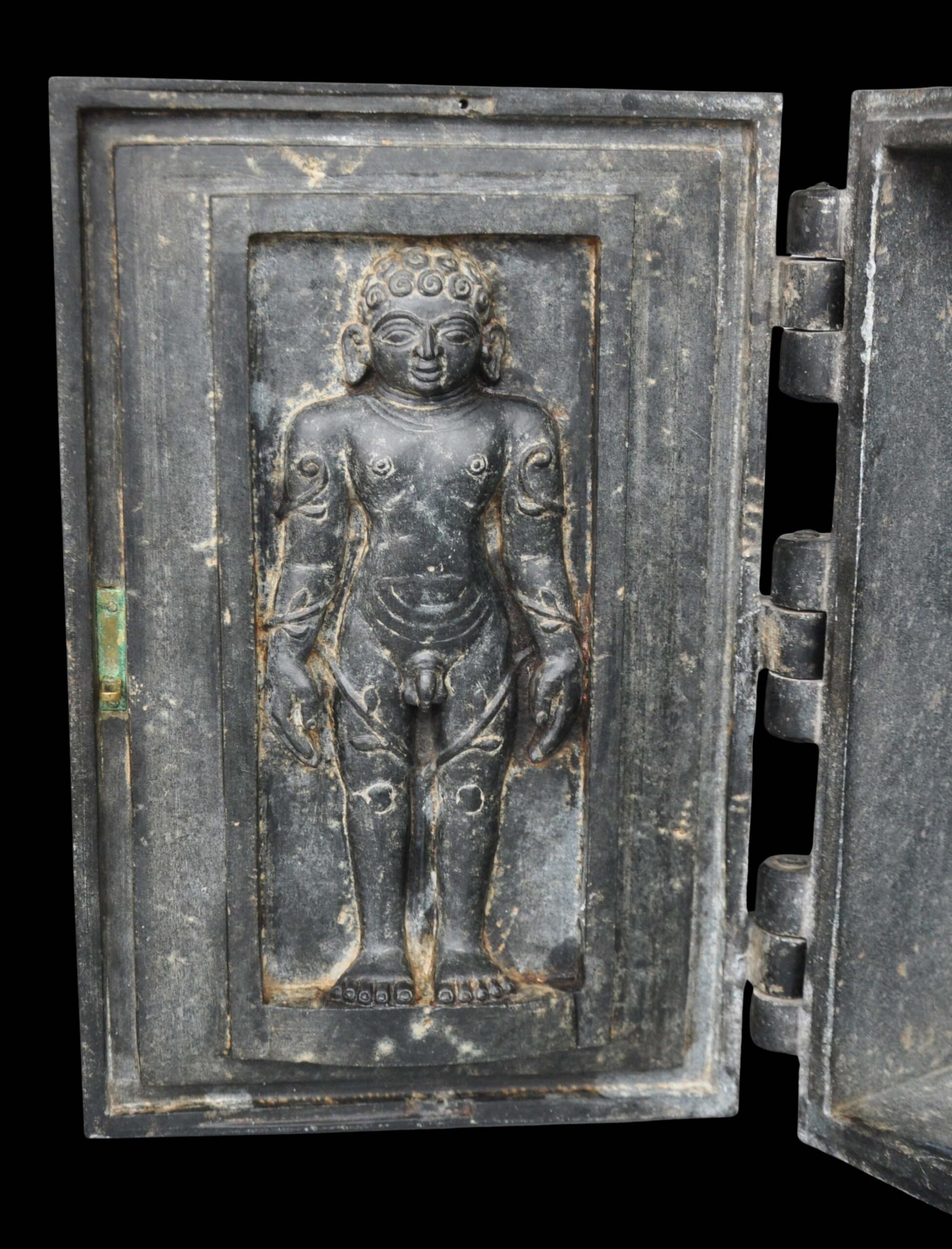
Inside, on the interior of the lid, is an image of Bahubali carved in high relief. Bahubali is shown as the main icon for worship, and is depicted naked, standing and with vines growing up around his legs. The standing position is known as kayotsarga (‘dismissing the body’ pose).
The box and cover are carved with hinge mounts. Each hinge mount is carved with a pipal leaf. It is likely that the box served as an unusual Jain shrine, and perhaps also as a protective storage box for religious paraphernalia.
A lock, and brass handles were fitted to each side. These have much age, wear and patina, and perhaps were fitted some time after the box was carved, perhaps by a later owner. (One handle now is missing.) The state of the brass fittings, particularly their obvious age, helps to confirm the box’s authenticity. The lid has two additional small holes probably to fit internal struts to support the cover when open. These are no longer present.
A much smaller example of such a box is in the British Museum and currently is on display. That example entered the museum’s collections in 1888. The Museum dates the box to the 17th or 18th century. The Museum’s example was believed to be a one-off until the appearance of this much larger example, which allows a reinterpretation of the Museum’s example. (The Museum suggests that its box possibly was for the storage of malas or religious rosaries. But perhaps these boxes served as reliquaries.)
It is likely that the two are from the same workshop. The Museum’s example is 4.8cm in height, 11.5cm in length and 8.3cm in depth/width. So clearly it is much smaller than the example here, which is approximately three times the size of the British Museum example.
Bahubali, also known as Gommateshwara, was the son of Rishabhanatha, a king who became the first tirthankara (enlightened teacher). After fighting his brother Bharata, Bahubali was filled with remorse and renounced his princely lifestyle. He retired to a forest and stood in meditation for so long that vines grew up around his body. Bahubali achieved moksha (‘liberation’) from rebirth and became a siddha (‘perfected one’). Bahubali is the son of a tirthankara but is not a tirthankara or a jina himself, though is worshipped as one. He is particularly popular among the Digambara Jains in south India, especially Karnataka or southern Maharashtra, which is where this box most likely is from. (A well-known, colossal image of Bahubali was erected by Chamundaraya, a Ganga dynasty general, in 981AD at Shravana Belgola in Karnataka.)
Grey-black steatite was among the stone types used to carve Jain religious figures such as images of jinas. (See for example, van Alphen, 2000, p. 143, for a 12th century image of a standing Adinatha, carved from a similar material as the box here.) Grey-black steatite was mined in Karnataka, suggesting a Karnataka provenance for such items.
Who are the Jains? Jainism emerged in the ascetic traditions of the Ganges Valley around the 8th-7th century BC. It grew out of Hinduism, but rejected the authority of the Vedas, the religious texts of the Hindus, and most particularly rejected the ritual of sacrifice. Instead, the Jains adopted non-violence, and in keeping with Buddhism which also emerged around the same time, they focussed on renunciation as a means of attaining liberation from the otherwise endless cycle of life and death. Jainism evolved into several sects. Jain adherents typically are vegetarian and Jain priests and nuns particularly have some of the strictest rules about food anywhere.
The box here is in fine condition. The three hinge struts are all in place, intact and functioning (unlike the British Museum example where both hinge supports are broken). The carving for the three tirthankaras is largely intact, as is the interior image of Bahubali. There is some loss to the lower left corner on the reverse of the box. On the inside, there is some loss to the interior rim of the edge on the right-hand side of the box, and on the left side, to the interior, a small part of the inner wall has been re-glued. None of these interior issues are visible from the exterior. Indeed, in reality, the conditions issues are relatively minor given the softness of the stone, the size of the box, its rarity, and its age.
In short, this is an outstanding, museum-quality item of great rarity. Other than the much smaller example currently displayed in the British Museum, we are not aware of other examples. This and the British Museum example are likely to be part of a one-off commission. The tirthankara figures and the image of Bahubali are all beautifully carved, and they are intact.
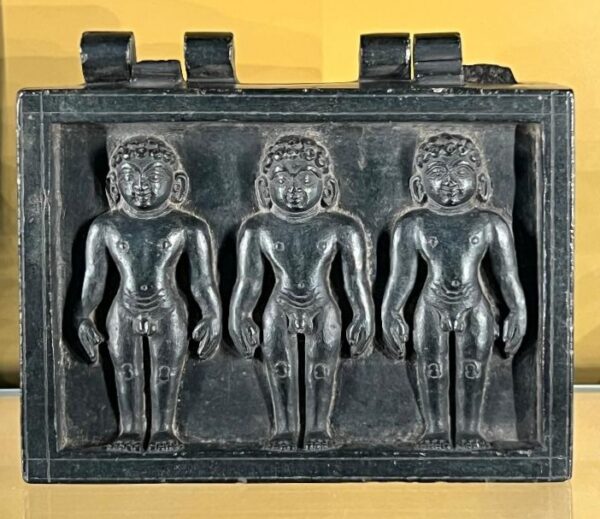
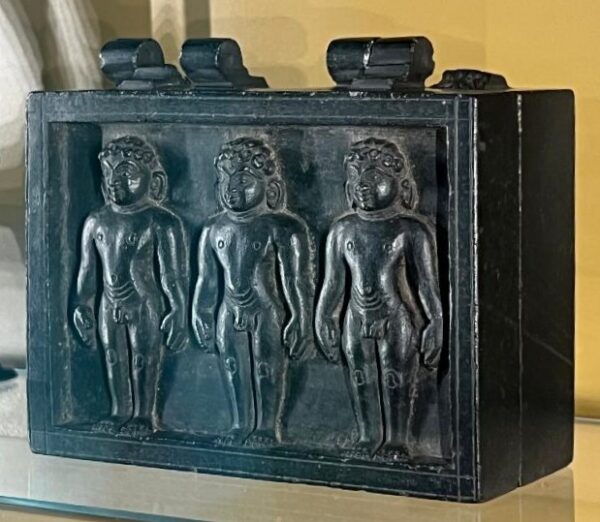
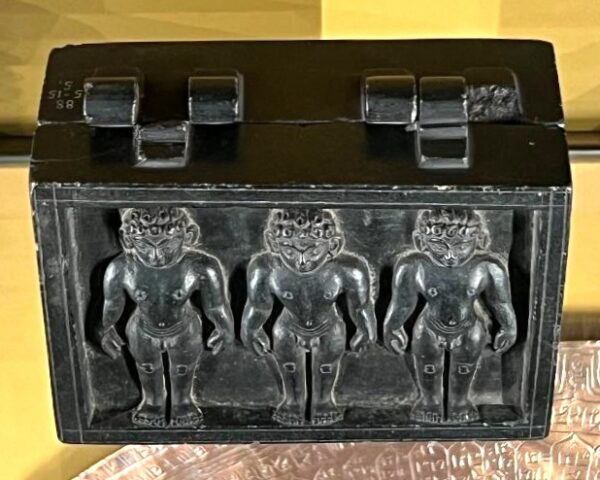
Above: Three images of the British Museum example, as displayed in the museum.
References
van Alphen, J., Steps to Liberation: 2,500 Years of Jain Art and Religion, Ethnographic Museum Antwerp, 2000.
Guy, J., Indian Temple Sculpture, V&A Publications, 2007.
Jansari, S., & S. Muthukamaran, Ancient India: Living Traditions, The British Museum, 2025.
Hegewald, J.A.B., Jaina Temple Architecture in India: The Development of a Distinct Language in Space and Ritual, Verlag Berlin, 2009.
Pal, P., The Peaceful Liberators: Jain Art from India, Thames & Hudson/Los Angeles County Museum of Art, 1995.